How often an aircond needs servicing in Kuala Lumpur is not one fixed number. It depends on how many hours the unit runs, the environment it sits in — dust, cooking, traffic, haze — the condition it is already in, and whether it is in a home or a commercial premises. A bedroom unit switched on at night and an air handler in a busy shop are not on the same footing. This guide goes through the factors so you can judge where your own unit sits, and gas top-up is covered separately because refrigerant is not something a healthy sealed system uses up on a schedule.
Almost every KL homeowner I meet asks the same thing: how often is “often enough”? The instinct is to copy the figure printed in the user manual — usually once a year. That number is fine for a temperate climate. It is wrong for Kuala Lumpur. In practice, a unit serviced annually in KL is a unit that spends most of the year running dirty.
Why Kuala Lumpur is different
Four things about KL gang up on your aircond, and none of them are accounted for in a generic manual:
- Constant heat. There’s no winter to give the unit a three-month rest. A KL compressor works hard 365 days a year, so wear and fouling never pause.
- High humidity. Moist air condensing on a cold coil is the perfect surface for mould and biofilm. This is why a neglected KL unit develops that musty smell within a year, not three.
- Urban dust and haze. Construction sites, traffic, and seasonal haze push fine particulate through the filter and onto the blower and coil. Units in Cheras, Sentul, or anywhere near a main road clog noticeably faster.
- Long daily run hours. KL bedrooms run the aircond every night, often. That’s double or triple the duty cycle a once-a-year schedule assumes.
Put together, a 1.5HP wall split that the textbook says to service yearly will, in a KL bedroom, lose meaningful cooling and start smelling musty long before that year is up.
Your servicing schedule, by scenario
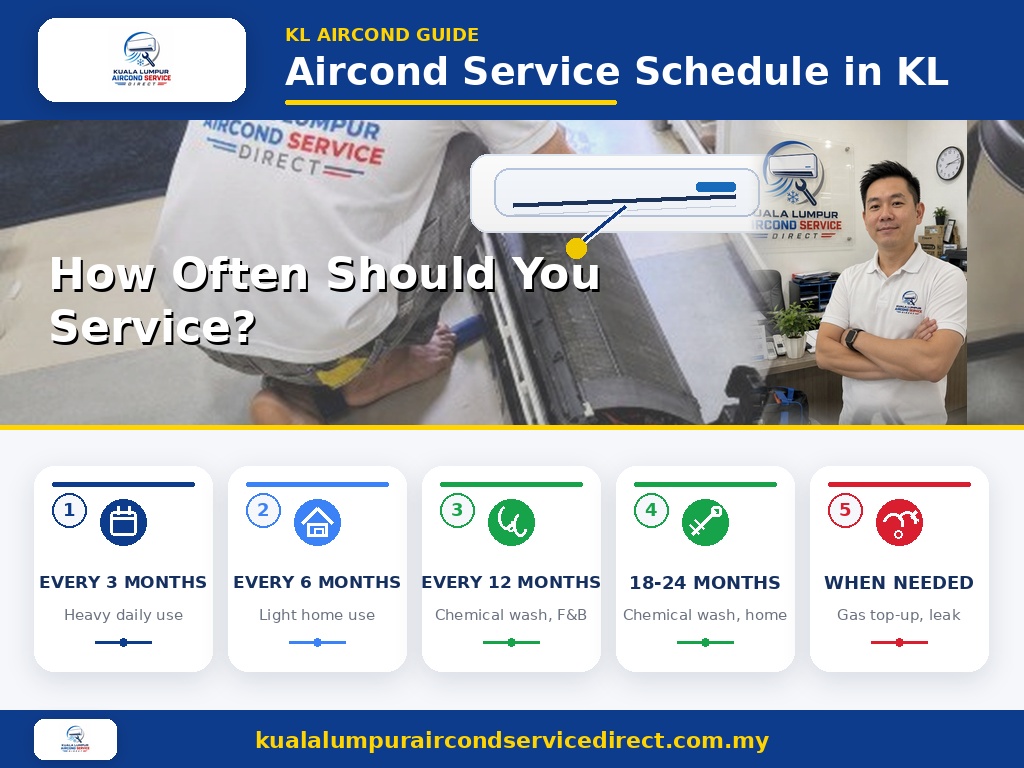
“How often” depends entirely on how hard the unit works. Here’s the schedule I actually recommend to KL clients, by situation:
| Scenario | Typical use | Service every |
|---|---|---|
| Bedroom, used nightly | daily | 3 months |
| Living hall | Evenings & weekends | 4 months |
| Home with pets | Fur + dander load | 2–3 months |
| F&B / café / clinic | grease/dust | 2 months + 12-mo chemical wash |
| Near construction / main road | Heavy particulate | 2–3 months |
| Spare room, light use | A few hrs/week | 6 months |
Bedrooms used nightly
The hardest-working unit in most KL homes. Running it overnight every night means the filter and blower load up quickly, and a clogged blower is exactly what makes a bedroom “never cold enough by 2am”. Quarterly is the realistic interval.
Homes with pets
Fur and dander get pulled straight into the return air and pack the filter and blower wheel. If you have a cat or dog, treat your schedule as one notch heavier than usual — every 2–3 months.
F&B and commercial
Cafés, restaurants, and clinics run long hours and pull in cooking grease or constant foot-traffic dust. These need a light service roughly every 2 months and a full chemical wash every 12 months to keep the coil from glazing over with grease.
Servicing vs chemical wash vs gas top-up
These three get muddled constantly, and the wrong one gets booked all the time. They are not interchangeable — each does a different job on a different schedule.
General service — every 3–6 months
This is the routine clean: filter, blower fan, drain pan, drainage line, plus a check of gas pressure and the electricals. It keeps the unit running clean. This is what most KL homes need on the quarterly cadence above. See what’s covered under aircond maintenance.
Chemical wash — every 18–24 months
Over time, dirt and biofilm bond to the evaporator coil itself, where a normal service can’t reach. A chemical wash dismantles the indoor unit and deep-soaks the coil in solvent, reaches build-up a regular service cannot. Residential units need this every 18–24 months; F&B every 12. It’s not something you do every visit — it’s the deeper reset.
Gas top-up — only on a leak
This is the big one people get wrong. Refrigerant is sealed in a closed loop; it does not “run out” or “get used up” like petrol. If your unit is low on gas, it has a leak — and topping it up without fixing the leak just buys a few weeks. So there is no schedule for gas top-up: you do it only when a leak test confirms one, and you fix the leak at the same time. Any technician who wants to “top up your gas” at every routine service is selling you something you don’t need.
Signs you’re overdue
The calendar is the safe default, but your unit will also tell you when it’s behind. Book a service if you notice any of these:
- Weaker cooling. The room takes longer to cool, or never quite gets there — usually a clogged filter and blower choking airflow.
- Musty or sour smell. Mould and biofilm on the coil. If a service doesn’t clear it, the coil needs a chemical wash.
- Higher electricity bill, same usage. A dirty coil makes the compressor work harder for the same cooling.
- Water dripping indoors. A drain pan or line clogged with biofilm. Left alone, it stains ceilings and walls.
Rule of thumb: if two or more of these show up at once, don’t wait for the next scheduled slot — the unit is already running dirty and costing you money on every bill.
What a proper service includes — and why DIY isn’t enough
Rinsing the filters yourself is good housekeeping, and it does help airflow. But the filter is the one part you can reach — and it’s rarely where the real problem sits. A proper service covers what your hands can’t:
- Blower fan wheel — the slatted barrel behind the filter, where compacted dust kills airflow. The single most-missed part in DIY cleaning.
- Evaporator coil — wiped and treated; deep-cleaned during a chemical wash when fouling is heavy.
- Drain pan and drainage line — flushed clear so the unit doesn’t drip onto your ceiling.
- Gas pressure and electrical check — pressure read at the service port, capacitor and wiring inspected before anything fails in the heat.
That’s why DIY filter rinsing stretches the gap between services slightly but never replaces one. The musty smells, the water leaks, and most of the lost cooling all live in parts you simply can’t get to without dismantling the unit.
FAQ
Is servicing every 3 months really necessary in KL?
For units that run daily — bedrooms used every night, living halls on most evenings — yes. KL’s heat, humidity, and urban dust foul the filter and blower faster than the textbook once-a-year guideline assumes. Lighter-use units can stretch to every 4–6 months, but quarterly is the safe default for nightly use.
Do I still need a service if I rinse the filters myself?
Rinsing filters helps airflow, but it doesn’t reach the blower fan, evaporator coil, drain pan, or gas pressure — which is where most cooling loss, musty smells, and water leaks actually come from. DIY rinsing extends the gap slightly, but it isn’t a substitute for a proper service.
How do I know if I need a chemical wash or just a normal service?
If a recent general service didn’t restore cooling, or the unit smells musty with visible black spots on the vents, the dirt is on the evaporator coil itself and needs a chemical wash. As a time rule, book a chemical wash every 18–24 months for a home and every 12 months for F&B, regardless of how the unit feels.